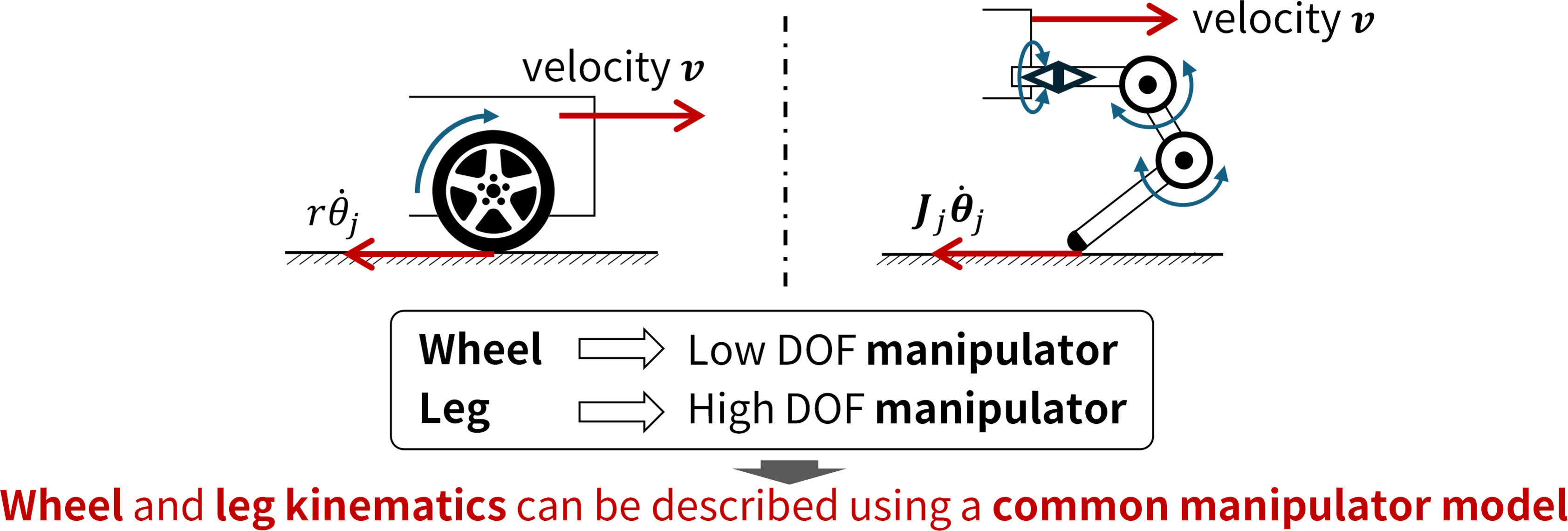
An N-legged robot’s body translational velocity is described by the velocity of the j-th contacting foot, treated as an end-effector.
Motivation
Generalizing learning-based kinematic models across robot embodiments
Kinematic models provide reliable motion constraints for odometry estimation in featureless environments, where exteroceptive sensing degrades and IMU integration drifts. Learning-based kinematic models can capture nonlinear robot–terrain interactions; however, most existing models are trained on a single embodiment and generalize poorly to new embodiments.
To address this challenge, KING explicitly incorporates robot embodiments by representing kinematic structures, embodiment parameters, and local proprioceptive motion signals as a common graph. A single graph neural network estimates body twist and contact poses for both wheeled and legged robots and can be adapted to morphologies unseen during pretraining through few-shot learning.
Unified kinematic-model representation
A common manipulator-based formulation of kinematics models for legged and wheeled robots
The body velocity of both legged and wheeled robots can be expressed in terms of the velocity at a ground-contact point, which is formulated as end-effector velocity in manipulator models. A leg is a higher-DOF manipulator with periodic ground contact, whereas a wheel is a lower-DOF manipulator with continuous ground contact.
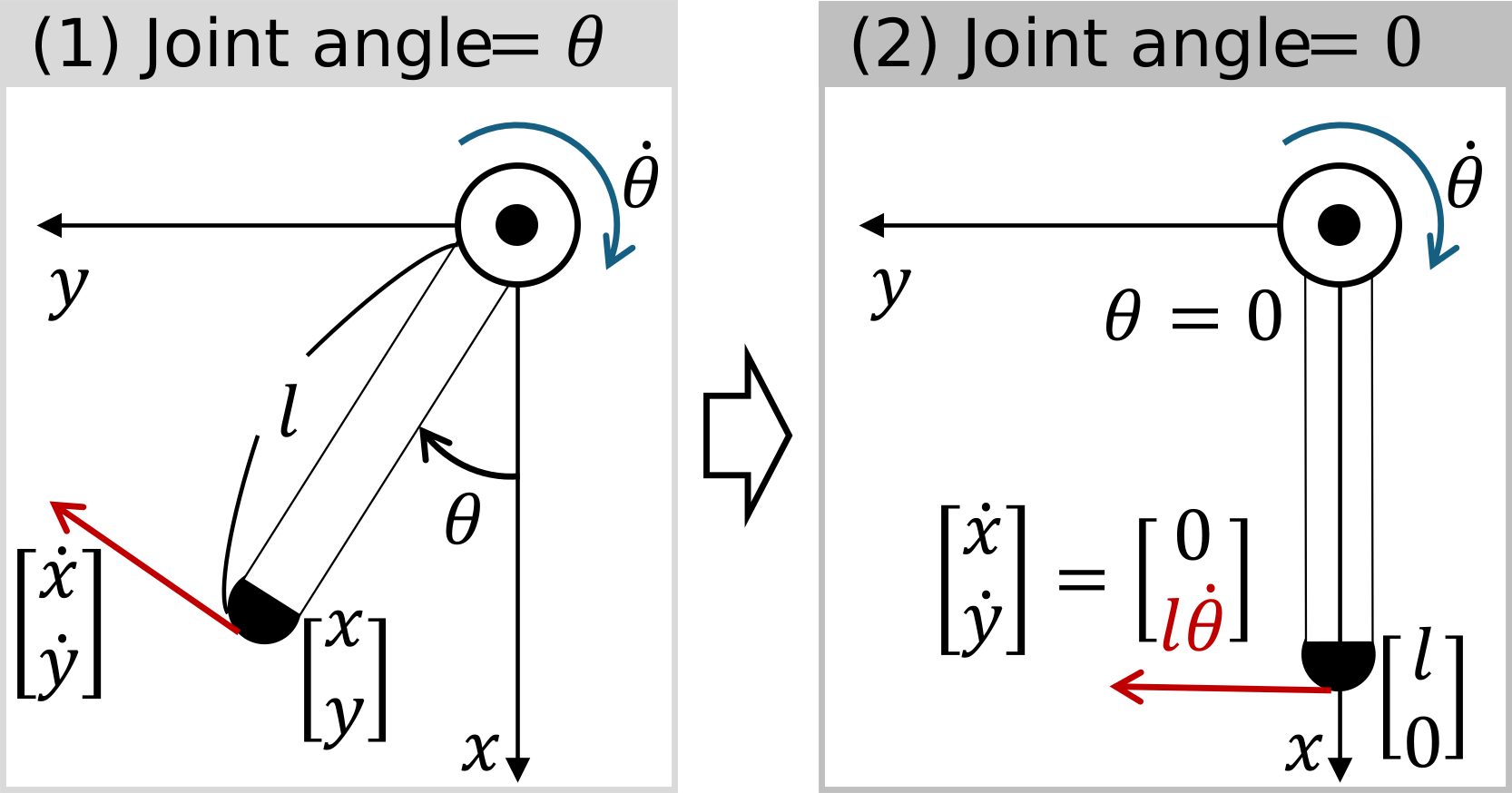
The wheel kinematic model is the 1-DOF special case, where the Jacobian matrix and joint angular velocity reduce to the scalar terms r and θ̇j.
System overview
Unified kinematic graphs for diverse robot embodiments
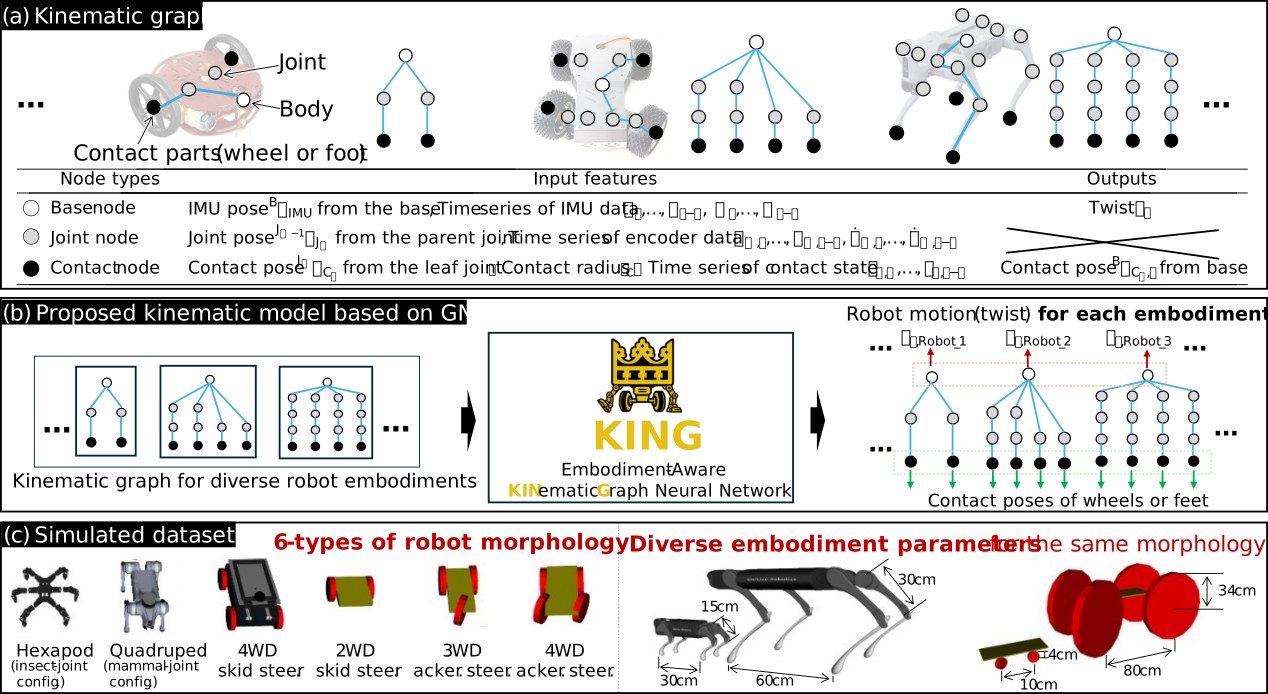
KING constructs a heterogeneous graph whose nodes correspond to the robot base, joints (actuators), and ground-contact elements (wheels or feet), referred to as Base, Joint, and Contact nodes. Edges are connected according to the robot’s kinematic connectivity.
Base node
Inputs: 6-DOF relative pose between the base and IMU frames, plus time-series linear acceleration and angular velocity measured by the IMU.
Output: body twist at the Base node.
Joint nodes
Inputs: initial 6-DOF relative pose between adjacent joint frames, joint angle, and angular velocity represented as 3D vectors.
Role: encode the rotation axis in the local joint frame and propagate local kinematic information.
Contact nodes
Inputs: 6-DOF relative pose from the adjacent joint frame to the contact frame, contact size, and time-series binary contact state.
Output: 6-DOF contact pose in the base frame.
KING architecture
Training KING via message-passing-based node regression
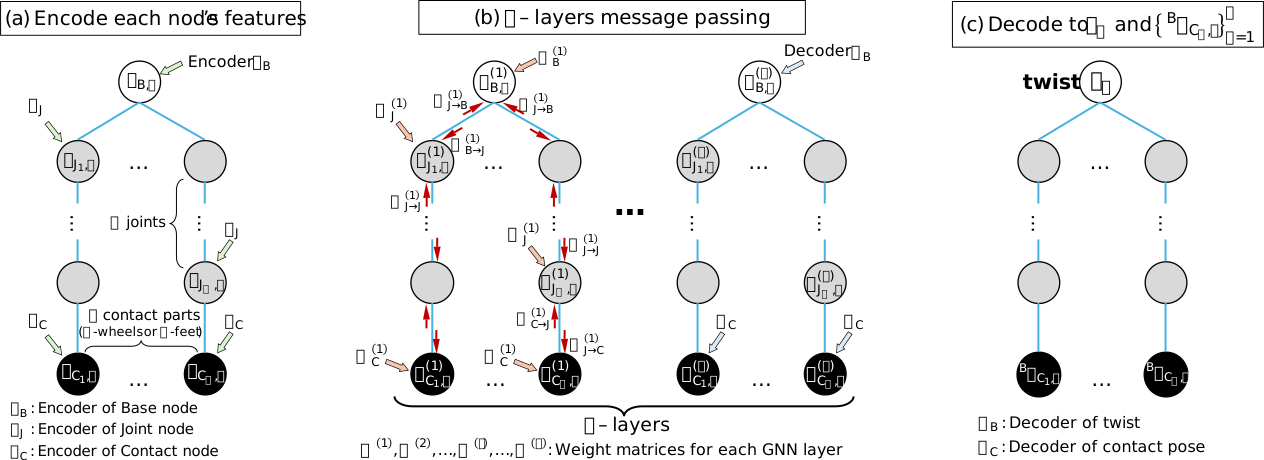
Base, Joint, and Contact features are mapped into latent embeddings using type-specific encoders and projected into a shared GNN hidden space. Message passing propagates node features along the robot’s kinematic connectivity. At the final GNN layer, the Base embedding is decoded into body twist, while the Contact embeddings are decoded into contact poses.
Type-specific encoding
Base, Joint, and Contact node features are mapped into latent embeddings by node-type-specific encoders and projection layers.
Shared message passing
The same message-passing update rule propagates information along embodiment-specific kinematic connectivity, regardless of the number of nodes and edges.
Node-wise decoding
The final Base embedding is decoded into body twist, while the final Contact embeddings are decoded into the 6-DOF poses of wheels or feet.
Experimental results
Few-shot sim-to-real transfer to unseen robot morphologies
For each testbed, the target morphology—and therefore all motion data from that morphology—was completely excluded from simulation pretraining. The resulting pretrained model was then fine-tuned using approximately one minute of real motion data to mitigate the sim-to-real gap.
01
Few-shot sim-to-real transfer on unseen real robot morphologies
No motion data from the evaluation target morphology were used during simulation pretraining. After pretraining on the remaining morphologies, KING was fine-tuned using approximately one minute of real data from the target robot.
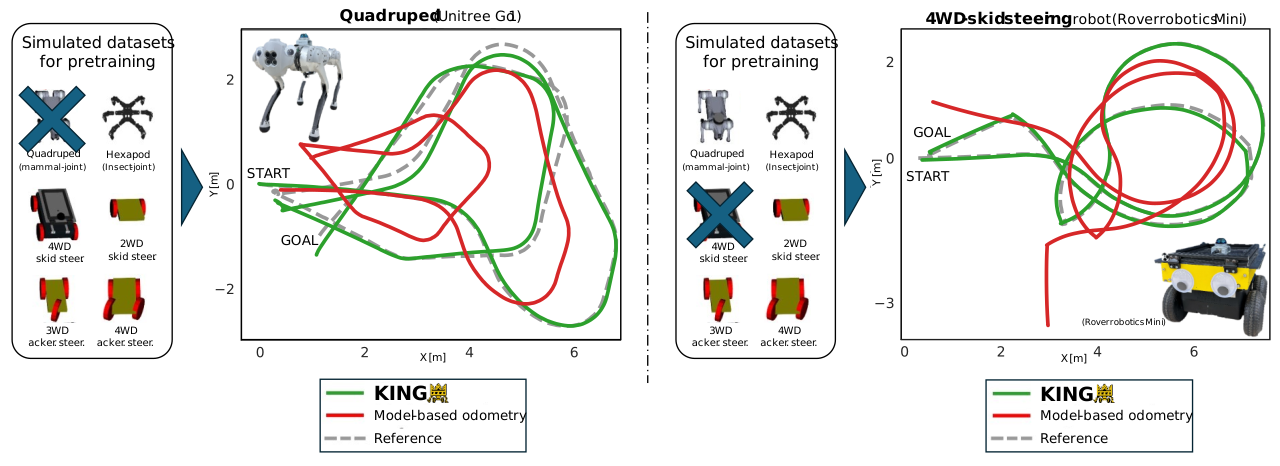
4WD skid-steer
0.038
m/s translational RMSE
0.022
rad/s rotational RMSE
Quadruped
0.049
m/s translational RMSE
0.026
rad/s rotational RMSE
On both platforms, few-shot adaptation enabled accurate odometry estimation. The results indicate that a kinematic model trained primarily on simulation can be transferred to real robots with morphologies unseen during pretraining through minimal real-world fine-tuning.
Future Works
Toward an Odometry Foundation Model
Our previous studies addressed terrain generalization by introducing terrain-dependent neural kinematic models and adapting them online to the current ground conditions. This online adaptation mitigates the need for data collection and batch retraining when a robot moves onto new terrain; however, those methods assume a single robot embodiment.
As future work, we plan to incorporate online learning into KING, following these wheel- and leg-odometry approaches. Combining KING’s unified representation across robot embodiments with online adaptation to terrain-dependent phenomena, such as wheel/foot slip and terrain deformation, is a step toward an odometry foundation model that can adapt to diverse robot embodiments and terrain conditions.
Online learned wheel-kinematic model
Tightly-coupled LiDAR–IMU–wheel odometry with online neural kinematic model learning via factor graph optimization (RAS 2025).
Online learned leg-kinematic model
Tightly-coupled LiDAR–IMU–leg odometry with online learned leg kinematics incorporating foot tactile information (RA-L 2025).
Paper
Read and cite KING
This article has been accepted for publication in the proceedings of the 2026 IEEE/RSJ International Conference on Intelligent Robots and Systems (IROS).
Open paper (PDF)@inproceedings{okawara2026king,
title = {KING: Embodiment-Aware Kinematic Graph Neural Network for Unified Motion Representation of Legged and Wheeled Robots},
author = {Okawara, Taku and Takanose, Aoki and Koide, Kenji and Oishi, Shuji and Yokozuka, Masashi},
booktitle = {2026 IEEE/RSJ International Conference on Intelligent Robots and Systems (IROS)},
year = {2026}
}